
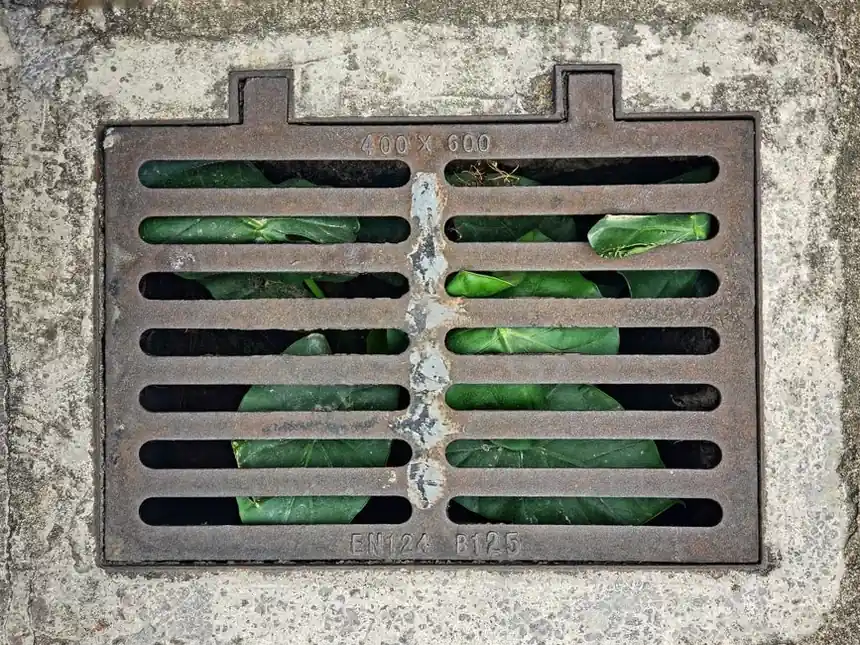
A catch basin is usually the right choice when rainwater runs across the surface and collects at a low point; a French drain fits soil that stays saturated or water that seeps through the ground. The quickest way to tell is to note whether water arrives visibly from above or emerges slowly from below, then track how long the area stays wet. The distinction matters across California, where intense winter storms can overwhelm a small inlet while clay soil or a high water table can keep a lawn soggy long after rain stops. Below, we explain what each system does, how to compare cost and site conditions, and when combining them makes sense.
A catch basin or French drain for yard drainage is a choice between a surface-water collection system and a buried system that intercepts groundwater or saturated soil. We begin with where the water travels, not with which product seems simpler.
What each drain is designed to do
A catch basin collects surface runoff at a low point in a California yard, while a French drain intercepts water moving through soil along a buried gravel-and-perforated-pipe trench.
A catch basin, also called an area drain or yard inlet, has a grated opening and a small chamber below grade. Water flows through the grate, sediment and leaves settle in the box, and an outlet pipe carries water to an approved discharge point. It works best where you can see water moving over paving or lawn toward a dip.
A French drain has no surface grate along most of its length. A perforated pipe sits in washed gravel, often wrapped or separated with filter fabric, and collects water entering through the soil. We use it to relieve a persistently wet strip, intercept hillside seepage, or carry subsurface water away from a foundation area when site conditions allow.
The key difference in a catch basin vs French drain decision is the entry point. A surface drain or subsurface drain for a yard is not interchangeable simply because both use buried pipe: the basin captures water from above, while the French drain gathers it from the surrounding soil. For broader Yard Drainage Repair in California, we trace that route before recommending a layout.
Is a catch basin or French drain better for standing water?
A catch basin is better for visible standing water when runoff gathers at a distinct low point; a French drain is better when the ground remains wet after surface water has drained away.
Watch a problem area during and after a storm. If a sheet of water crosses the patio or lawn, forms a puddle at a depression, and recedes after the rain stops, an inlet can capture that concentrated flow. If there is no obvious flow path but the soil feels spongy a day or two later, a perforated trench is more likely to address the source.
Timing and depth give useful clues. A puddle several inches deep after a heavy shower deserves attention if it remains for more than 24 hours; repeated saturation lasting 48 hours or longer suggests slow infiltration, a blocked outlet, or subsurface seepage. These are diagnostic clues, not universal pass-or-fail thresholds: soil type, slope, and rainfall intensity change the pattern.
In the East Bay, sloped lots can send runoff toward a flat backyard, while compacted or clay-heavy soil can slow drainage. We see both patterns in Yard Drainage Repair in Concord, where the right yard drainage system comparison starts with observing the flow after rain rather than guessing from the lawn's appearance.
Match the drainage system to the symptoms
Homeowners in California can match a drainage system to symptoms by checking the water's path, the wet area's shape, and how long soil stays saturated after rain.
Use this field check before choosing a catch basin for standing water or a French drain for a soggy lawn in California. Walk the yard during a storm only where footing is safe, then inspect it again after the rain passes.
- Water moves across the surface: A catch basin or area drain often fits a visible flow path that converges at one low spot.
- Water seeps from a slope or hillside: A French drain placed across the seepage route can intercept subsurface flow before it reaches the lawn.
- A broad lawn stays spongy: Look for compacted soil, a high water table, or a drainage outlet problem; one small basin will not dry the whole area.
- Water pools beside a downspout: A surface inlet may collect discharge, but the downspout connection and final outlet also need to be checked.
- Water collects against a wall or foundation: Correct the surface grade and direct water away; do not rely on a drain that has no safe outlet.
Our diagnosis includes checking grade with a level or laser, locating existing pipes where possible, and confirming where water can legally and practically discharge. A slope of about 1%-roughly 1 inch of fall over 8 feet-can move water through many yard drain layouts, though exact grade depends on pipe size, material, and conditions.
That assessment helps distinguish an area drain versus perforated pipe drainage, and it can identify a third option. Where a long, narrow paved strip sheds runoff, a channel or trench drain may collect water more effectively than a single grate. For planned Yard Drainage Installation in California, we design the inlet, pipe, and outlet as one connected route.
Compare installation costs and site conditions
In California, a small catch basin installation often costs about $800-$2,500, while a French drain commonly runs $25-$60 per linear foot, with excavation and access driving the final price.
Those are planning ranges for typical 2026 pricing, not a quote for every property. A basin connected to a nearby, usable outlet may require only a short trench; a French drain running 40 feet through established landscaping can cost roughly $1,000-$2,400 before difficult access, restoration, or special discharge work. Multiple inlets, deeper excavation, concrete removal, and rock raise the total.
Cost comparison is useful only after the system is matched to the water. A catch basin can be less expensive for a single surface low spot, but it will not pull water out of saturated soil. A French drain can address a long wet zone, but it is wasteful if the actual issue is a fast surface flow that could be captured at one point.
We also check California site constraints. A discharge cannot simply shift runoff onto a neighbor's property, and stormwater rules and local requirements differ by jurisdiction. Before digging, we identify buried utilities through the appropriate utility-marking process; trench depth, nearby foundations, tree roots, and existing irrigation all affect the installation plan.
When a French drain is the right fit, our French Drain Installation and Repair in California work focuses on trench placement, suitable washed aggregate, pipe fall, and a maintainable outlet. A perforated pipe needs a path for water to leave; gravel alone does not solve a drainage problem.
Can a yard use both a catch basin and a French drain?
Yes, a yard can use both systems when surface runoff and subsurface saturation occur in separate areas or at different points along the same drainage route.
For example, a basin can collect runoff at the bottom of a paved slope while a French drain intercepts seepage along the uphill edge of a lawn. The systems may connect to a properly sized solid outlet pipe, but their connections need careful design so intense surface flow does not push debris or water backward through perforated pipe.
We do not join drains just because two pipes happen to be nearby. We calculate where water enters, estimate how much the outlet must carry during a storm, and include access for cleaning. A basin with a removable grate and sediment chamber is easier to maintain than a hidden junction that cannot be reached.
Common mistakes that leave yards wet
California yards stay wet after drainage work when the system captures the wrong water, has no reliable outlet, or is installed without accounting for soil and maintenance.
These errors often explain why a new drain does not change the puddle:
- Installing a basin in the middle of a broad, flat wet lawn without creating a route that directs water to it.
- Using a French drain to solve obvious surface runoff without grading the ground or providing a surface inlet.
- Ending a pipe in a low spot where water backs up during the next storm.
- Wrapping the trench in unsuitable fabric or using fine, dirty aggregate that clogs the system.
- Skipping routine cleaning: leaves and sediment can fill a basin chamber, so inspect it at least twice a year and after major storms.
Fall is a good time to check grates and clear leaves before California's winter rains. In a drought-prone summer, dried or compacted soil can also shed the first heavy rain instead of absorbing it, so observe the first storms rather than assuming a formerly dry yard has no drainage issue.
When to call a drainage professional
A drainage professional in California should inspect a yard when water reaches a foundation, repeatedly floods usable space, or remains saturated for more than 48 hours after rain.
Call sooner if you see soil erosion, a retaining-wall leak, water entering a crawlspace, or a drain that backs up during storms. Those signs can point to a failed outlet or a larger drainage route, not just a clogged grate. We can inspect grade, trace where water starts, and explain whether a basin, French drain, or combined system fits the site.
Northern California Drainage Experts handles yard drainage inspection, repair, and installation. If you need a drainage contractor to recommend a yard drain system in California, we'll base the recommendation on the actual water path and a workable discharge point.
Frequently Asked Questions
Which drain handles surface runoff more effectively?
A catch basin handles concentrated surface runoff more effectively than a French drain because its grate receives water directly from above. Position it at the low point and connect it to an outlet that can carry the flow. For a long paved edge, a channel drain may collect the water more evenly.
How do I choose the right yard drainage system in California?
Track whether water flows over the surface or seeps through soil, then note the wet area's location and how long it lasts. A distinct puddle points toward an inlet; a broad, persistently saturated strip points toward subsurface drainage. We also check grade, soil, utility locations, and a legal outlet before selecting a system.
When should I use a yard inlet instead of a French drain?
Use a yard inlet when runoff visibly converges at a low point, especially beside a patio, walkway, or downspout. A grate captures water immediately, while a French drain collects water moving through soil. If both conditions exist, a combined design may work better than either drain alone.
How often should I clean a catch basin?
Inspect a catch basin at least twice a year and after a major storm; remove leaves and sediment before they block the outlet. Homes under trees often need more frequent checks in fall. If the basin fills quickly or water stands in it between storms, have the pipe and discharge point checked.
Get help with Yard Drainage Repair in California
If you're unsure whether the water is running over your lawn or rising through it, Northern California Drainage Experts can inspect the grade and recommend a system that carries water to a workable outlet. Call +1 (310) 388-1903 to discuss your yard drainage problem.